
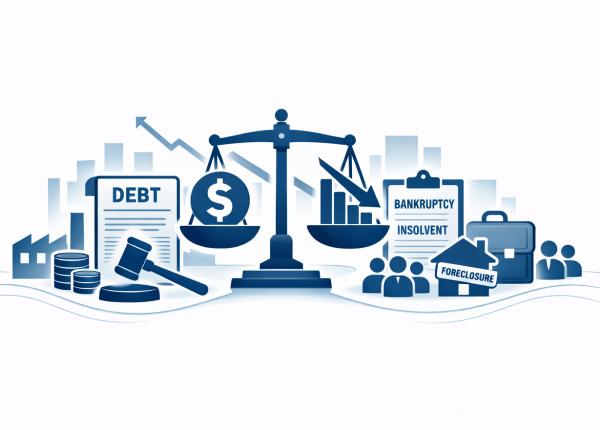
Insolvency law regulates those legal mechanisms, which are used then, when a debtor cannot fulfill or objectively is no longer able to fulfill their own monetary obligations in a timely manner. The goal of insolvency law is the fair protection of the interests of creditors, the maximally effective distribution of assets and, in case of possibility, the rescue of a still liquid business entity.
Insolvency represents a factual state, when the debtor cannot fulfill due obligations, while bankruptcy is a legal procedure, which is initiated by the court on the basis of insolvency.
The basis for starting insolvency proceedings is the insolvency of the debtor or the expected insolvency. Insolvency proceedings begin by filing a statement about insolvency in court with the demand of opening a rehabilitation or bankruptcy regime. Insolvency proceedings can be carried out: a) by a rehabilitation regime; b) by a bankruptcy regime.
Creditors have the right to declare their demands and in accordance with the priorities established by law to satisfy them. The debtor is imposed with the obligation to cooperate with the bodies implementing the procedure, to fully disclose assets and to refrain from such actions, which damage the interests of creditors. The rights and obligations of both parties are strictly regulated by law. The creditor has the right, within a term of 30 days from receiving the notification regarding the recognition as admissible of the statement about insolvency, to apply to the manager/supervisor of rehabilitation (in case of existence) and submit to him the creditor demand, if it differs from the amount of the demand recognized by the debtor. This term can be restored in accordance with Article 65 of the Civil Procedure Code of Georgia. Any demand submitted after the expiration of this term is considered delayed. The creditor, to whom a notification was not sent in accordance with the law, has the right to submit the demand within a term of 30 days from learning about the proceedings of the insolvency case, but not later than 1 year from the issuance of the ruling regarding the recognition as admissible of the statement about insolvency and the opening of the rehabilitation or bankruptcy regime, except for that case, when the limitation period of the demand foreseen by the Civil Code of Georgia has expired. After the expiration of the established term, the submission or increase of the demand is impermissible. A creditor demand is a debt or a demand for the fulfillment of an obligation, which can be expressed in monetary form, the obligation of fulfillment of which or the responsibility for the fulfillment of which at the moment of recognition as admissible of the statement about insolvency is imposed on the debtor and which, without any limitation, includes due demands, unspecified demands, conditional demands, and undue (future) demands.
Legal services ensure the legal support of both the debtor, as well as the creditor at all stages of the procedure. A lawyer evaluates risks, prepares demands and plans of rehabilitation, controls the legality of the process, and protects the financial interests of the client. Legal involvement is decisive for the effective and fair management of the process of insolvency.